


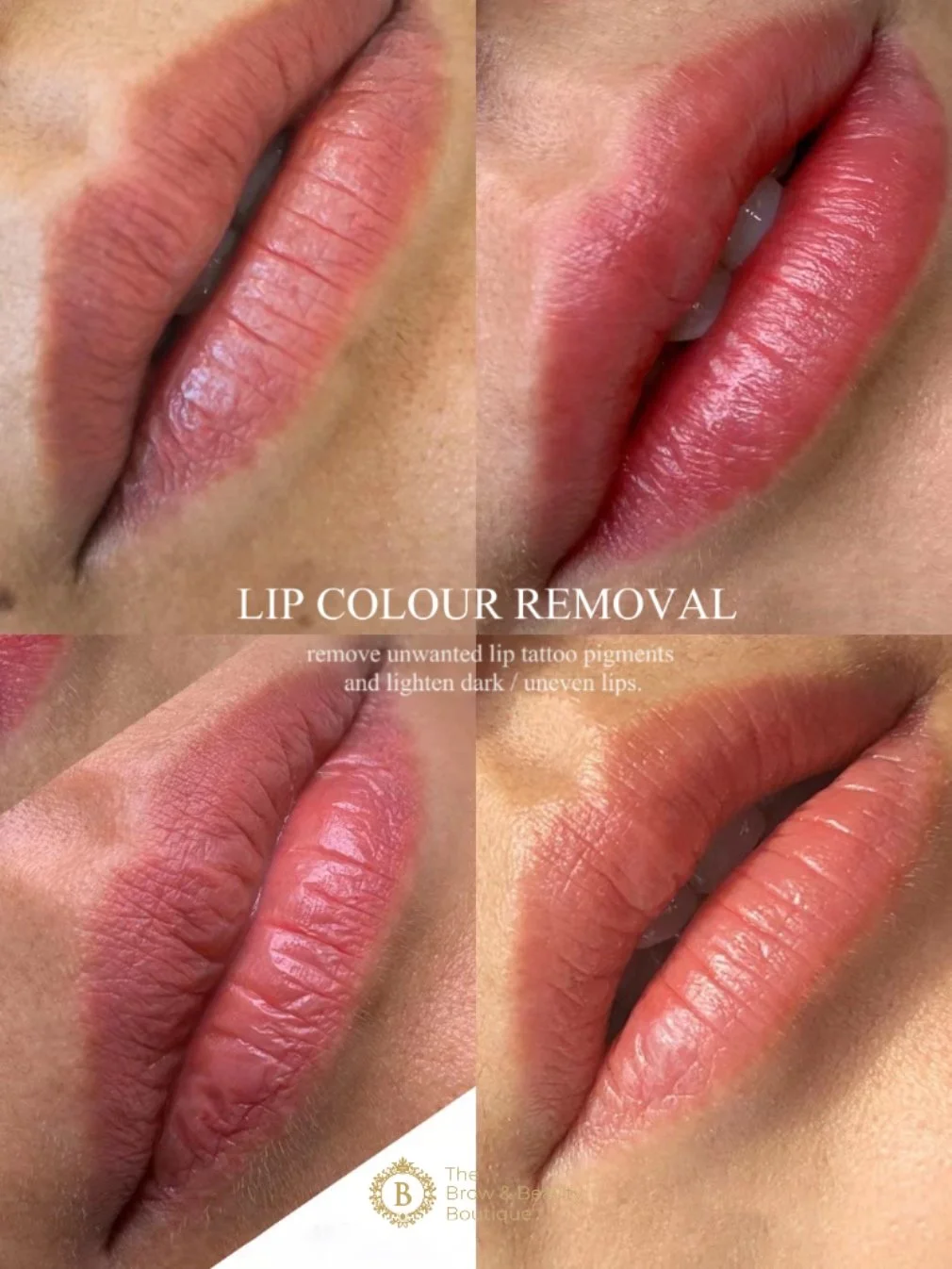

One of the most misunderstood aspects of lip correction is when pigment reduction is actually required. Many clients assume that uneven, dull, or shifting lip colour can always be resolved by adjusting pigment choice or adding corrective tones. In reality, there are situations where predictable lip colour correction is not possible unless excess or unstable pigment is first reduced.
At The Brow & Beauty Boutique, pigment reduction is never treated as a default step, nor is it positioned as an extreme measure. It is used strategically, when the existing pigment environment prevents colour stability, clarity, or long-term aesthetic control.
Predictability Depends on the Existing Pigment Environment
Lip colour correction succeeds when pigment behaves consistently within the tissue. When outcomes are unpredictable, the cause is usually not the new pigment itself, but the conditions it is being placed into.
Pigment reduction becomes necessary when one or more of the following are present:
Excessive pigment density from previous treatments
Deep dermal placement that produces cool or muted tones
Layered pigment from multiple sessions over time
Residual or legacy pigment interfering with new colour
Uneven pigment load across different lip zones
In these situations, adding more pigment does not restore control. It reduces it.
Why “Corrective Colour” Alone Often Fails
Corrective colour theory works best on stable foundations. When lips already contain high pigment load or depth inconsistency, neutralising tones may temporarily improve appearance, but they do not resolve the underlying instability.
Common outcomes of colour-only correction on unstable lips include:
Initial improvement followed by gradual colour shift
Recurring grey, purple, or muddy undertones
Patchy retention during healing
Increased difficulty with future corrections
This is why experienced correction specialists do not treat pigment reduction as a setback. It is often the only way to restore predictability before refinement can occur.
Pigment Reduction Is About Control, Not Erasure
A common misconception is that pigment reduction means completely removing all existing colour. In most lip correction cases, this is neither necessary nor desirable.
At The Brow & Beauty Boutique, pigment reduction is used to:
Lower excessive pigment density
Lighten deep or cool-toned residual pigment
Improve balance across the vermilion zone
Restore clarity so new colour can behave predictably
This controlled approach allows the tissue to reset without compromising its integrity, making subsequent embroidery safer and more reliable.
You can learn more about this corrective phase through our dedicated lip colour removal service, which is designed specifically for precision reduction rather than aggressive clearing.
Signs That Pigment Reduction May Be Required
Pigment reduction is often recommended when lips exhibit patterns that cannot be corrected through surface-level adjustments alone. These may include:
Persistent grey or purple tones despite neutralisation
Uneven colour distribution that worsens over time
Areas that repeatedly heal darker than expected
Colour that shifts unpredictably months after healing
A visible mismatch between lip zones
These are not signs of poor healing. They are indicators that the existing pigment structure is limiting outcome control.
Why Reduction Improves Long-Term Results
When excess or unstable pigment is reduced, the lip tissue responds differently to subsequent treatments. Colour settles more evenly, undertones stabilise, and healing outcomes become easier to anticipate.
Pigment reduction supports:
Improved colour clarity
More even saturation
Reduced risk of future hue distortion
Greater longevity of aesthetic results
This is why reduction is framed as a supportive step, not an isolated procedure. It enables better results rather than replacing them.
Embroidery After Reduction Is More Reliable
Once pigment load has been recalibrated, lip embroidery can be performed with significantly greater precision. On stabilised tissue, pigment placement behaves more consistently, and colour outcomes align more closely with expectations.
This is why lip embroidery is positioned as a completion phase, not a corrective shortcut. When applied to a balanced foundation, embroidery enhances natural tone, shape, and softness without fighting against underlying instability.
Clients moving into this stage may explore lip embroidery blush or lip embroidery enhancement as the appropriate next step.
Assessment and Sequencing Matter More Than Speed
Pigment reduction is not recommended lightly. It is advised only after careful assessment of pigment depth, density, history, and tissue response. At The Brow & Beauty Boutique, every correction plan is sequenced intentionally to protect both aesthetic outcomes and tissue health.
Clients are guided through:
Clear explanation of why reduction is or is not required
Honest discussion of limitations and expectations
A staged plan designed for long-term stability
Opportunities to ask questions at every stage
This ensures decisions are informed, not rushed, and outcomes remain predictable rather than hopeful.
For insight into real correction journeys where reduction played a key role, our customer stories provide valuable perspective.
Predictable Results Require the Right Foundation
When pigment reduction is recommended, it is because predictability depends on it. Without addressing excess or unstable pigment, even the best embroidery techniques are forced to compensate for conditions they cannot fully control.
If your lip colour has healed but remains inconsistent, muted, or unpredictable, pigment reduction may be the step that restores clarity and confidence in your results.
You may begin the appropriate stage of your journey by scheduling directly:
To learn more about our philosophy and corrective approach, you may also visit The Brow & Beauty Boutique.