
Why Staged Lip Color Removal Leads to More Reliable Correction Outcomes
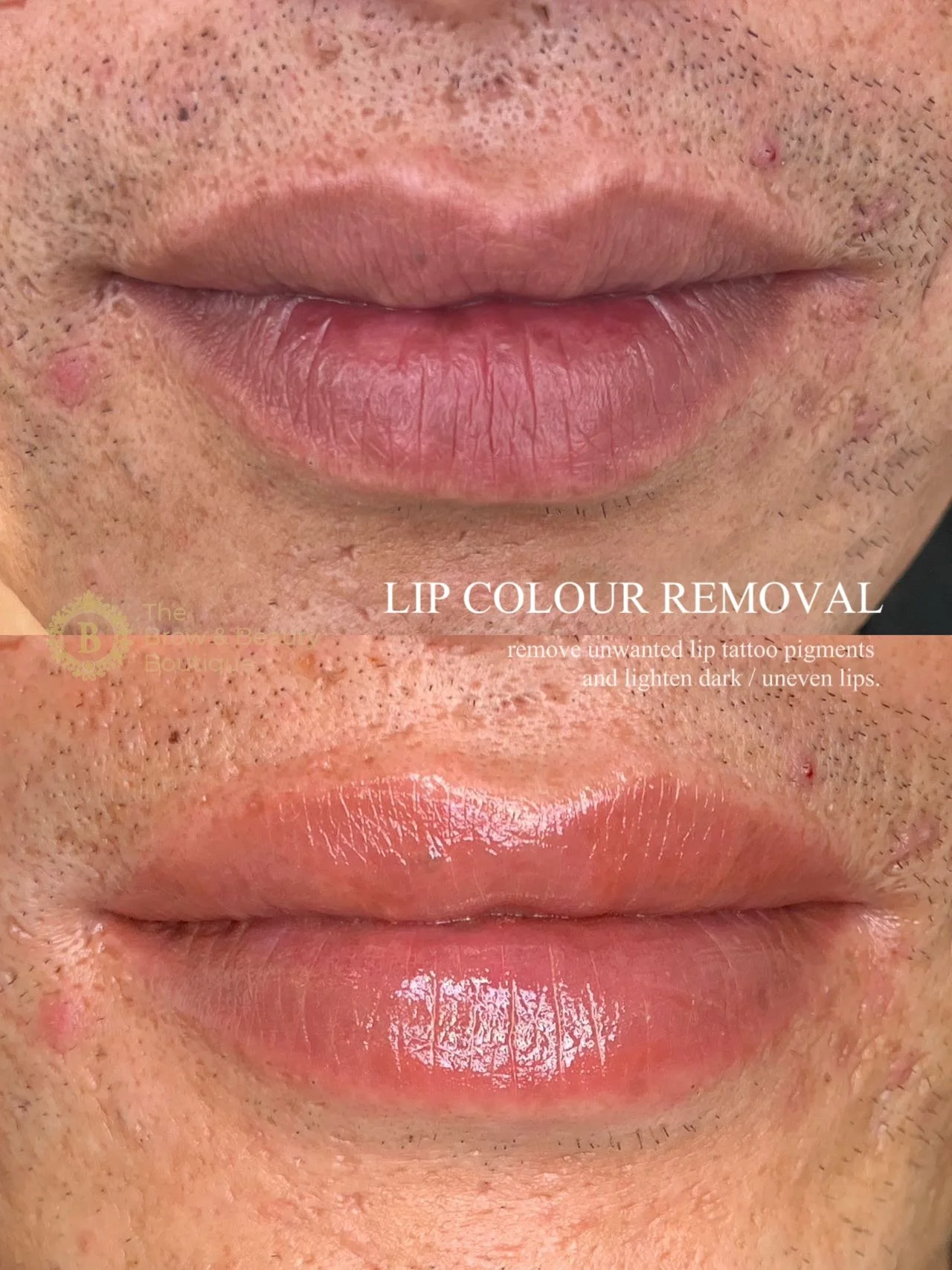


When lip colour correction feels unpredictable, the issue is rarely the colour choice itself. Clients often describe results that look acceptable at first, only to shift weeks or months later into grey, purple, or uneven tones. This pattern is not random. It is a clear indicator that pigment reduction was rushed or incomplete, and that correction was attempted before the tissue environment had stabilised.
At The Brow & Beauty Boutique, lip colour removal is approached as a staged process, not a single corrective event. This staging is the key reason correction outcomes become more reliable, more predictable, and more durable over time.
Why Immediate or Aggressive Removal Undermines Correction
Lip tissue is resilient, but it has limits. When pigment has accumulated over multiple sessions, it sits at different depths, densities, and states of oxidation. Attempting to remove all pigment quickly or aggressively often introduces new instability rather than resolving the old.
Overly rapid removal can lead to:
Uneven pigment clearance
Variable healing responses across the vermilion
Increased inflammation and tissue stress
Difficulty assessing true residual pigment behaviour
In these cases, correction may proceed based on incomplete information. New colour is applied before the lips have fully revealed how much pigment remains or how the tissue is responding biologically.
What “Staged Removal” Actually Achieves
Staged lip colour removal is designed to reduce pigment load progressively, allowing the tissue to respond, stabilise, and declare itself clearly between stages. Each phase provides critical information that informs the next step.
This approach allows practitioners to:
Identify which pigment is truly residual versus transient
Observe how undertones behave after reduction
Avoid over-removal that compromises tissue tolerance
Restore predictability gradually rather than forcefully
Rather than treating removal as a race to clarity, staging treats it as a diagnostic and corrective process combined.
Pigment Behaviour Reveals Itself Over Time
One of the most important reasons staged removal leads to better outcomes is that pigment behaviour changes after each reduction phase. Colour that initially appears dominant may soften. Undertones may shift once deeper pigment is partially cleared. Areas that seemed uneven may equalise naturally as tissue stress reduces.
This information is invaluable. Without allowing time between stages, corrective decisions are made blindly. With staging, each step is guided by how the lips actually behave, not how they are expected to behave.
This is why lip colour removal is framed as a foundational correction step rather than a standalone solution. You can learn more about this approach through our dedicated lip colour removal service.
Why Staging Improves Colour Correction Accuracy
Colour correction relies on predictability. When pigment load is lowered gradually, the tissue environment becomes more consistent. Light reflection improves, undertone dominance reduces, and healing responses stabilise across the lips.
As a result:
Corrective colour reads more accurately
Undertones remain stable after healing
Both lips respond more symmetrically
Fewer corrective sessions are required overall
This is not because the colour theory changes. It is because the canvas becomes reliable again.
The Relationship Between Removal and Embroidery
Lip embroidery is most successful when it is performed on stabilised tissue. When embroidery is applied too early, it inherits the same instability as the underlying pigment environment. When applied after staged removal, it behaves predictably and ages better.
At The Brow & Beauty Boutique, embroidery is positioned as a completion phase, never as a shortcut around unresolved pigment issues. Clients who progress through staged removal often experience smoother healing and more consistent long-term colour once embroidery is introduced.
Refinement options at this stage may include lip embroidery blush or lip embroidery enhancement, depending on the desired outcome and tissue readiness.
Why Not Every Case Requires the Same Number of Stages
Staged removal does not mean a fixed number of sessions for every client. Some lips require minimal reduction. Others need more gradual recalibration. The determining factor is tissue response, not a preset formula.
This is why assessment and reassessment are built into the process. Each stage informs whether further reduction is necessary or whether the lips are ready to move forward. This adaptive approach prevents over-treatment while maximising predictability.
For insight into how different correction journeys unfold, our customer stories provide real-world examples of staged correction in practice.
Reliability Comes From Respecting Biology
The reason staged lip colour removal produces more reliable correction outcomes is simple. It works with biological limits rather than against them. By reducing pigment load in phases, allowing stabilisation, and responding to what the tissue reveals, correction becomes controlled instead of speculative.
If your lip colour has resisted previous correction attempts, the issue may not be the colour chosen. It may be that pigment reduction was rushed or incomplete.
You may begin the appropriate stage of your correction journey by scheduling directly:
To learn more about our correction-led philosophy and full range of services, visit The Brow & Beauty Boutique.
