
Lip Colour Removal as the First Step in Predictable Lip Correction


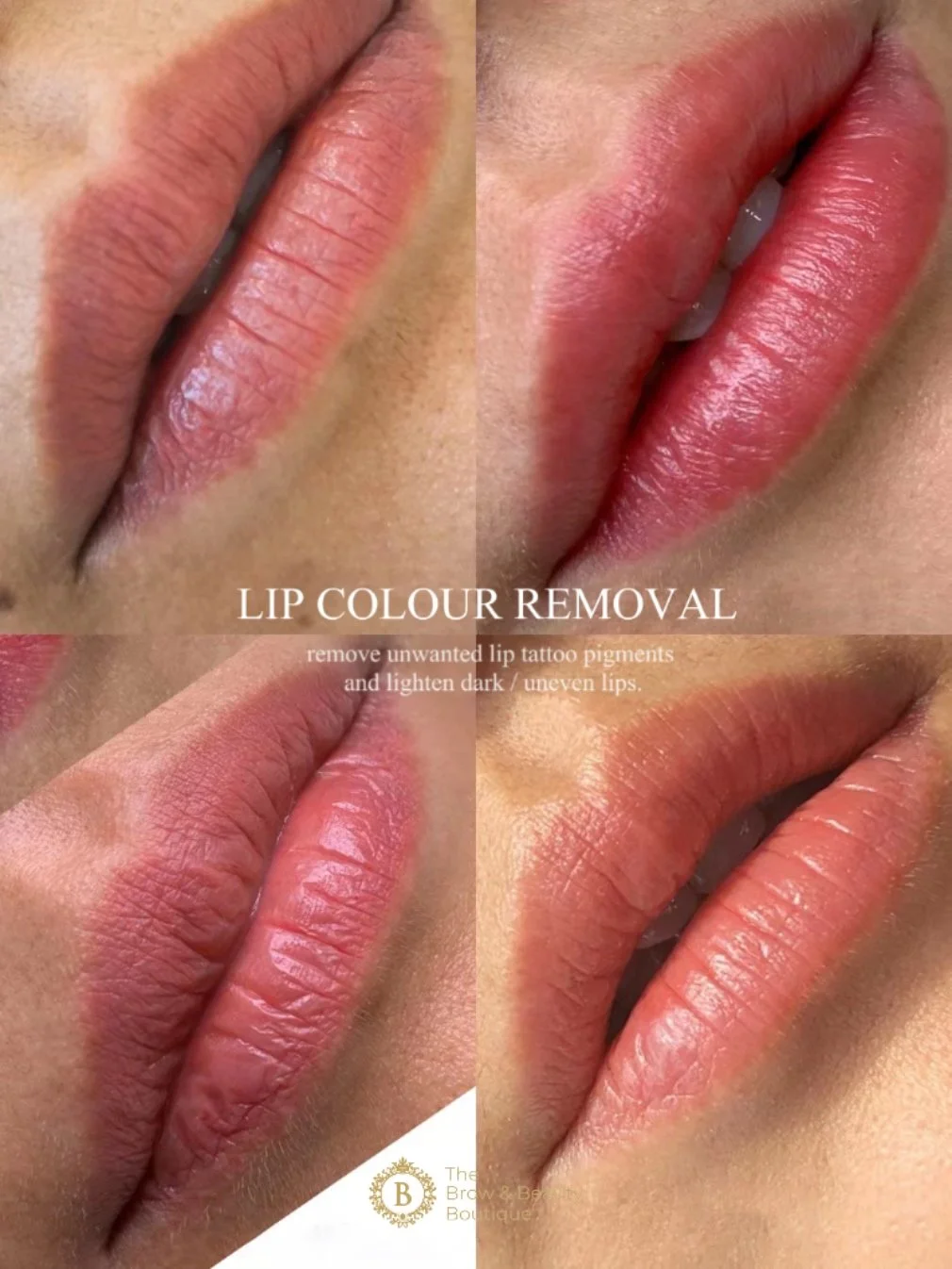
When lip colour results feel unpredictable—shifting undertones, uneven saturation, or tones that change months after healing—the issue is rarely the final colour choice. In most cases, unpredictability begins before any correction pigment is applied. It begins with what already exists in the tissue.
At The Brow & Beauty Boutique, lip colour removal is not positioned as a last resort. It is recognised as the first and most important step in achieving predictable, stable lip correction outcomes.
Predictability Requires a Stable Foundation
Predictable correction depends on consistency. Consistent pigment depth, balanced pigment load, and tissue that responds uniformly during healing. When these conditions are absent, colour outcomes become variable regardless of how carefully corrective pigment is chosen.
Many lips requiring correction already contain:
Residual or legacy pigment from previous treatments
Uneven pigment density across the vermilion
Mixed pigment types interacting at different depths
Areas of cumulative pigment trauma
These variables introduce too many unknowns. Without first reducing or stabilising them, colour correction becomes an estimate rather than a controlled process.
Why Existing Pigment Undermines Correction Accuracy
Existing pigment does not fade evenly, nor does it behave passively. Even when it appears light on the surface, residual pigment continues to influence optical colour output.
When new corrective pigment is applied over unstable existing pigment:
Light reflects through multiple pigment layers
Undertones mix unpredictably
Depth inconsistencies distort hue
Healing behaviour varies across lip zones
This is why some lips look acceptable immediately after treatment, only to shift later. The issue was never the corrective colour. It was the environment it was placed into.
The Limits of Colour-First Correction
Colour-first correction assumes that pigment behaviour is predictable. In reality, this is only true when pigment load is low and evenly distributed.
Without prior pigment reduction, colour-first approaches often lead to:
Short-lived improvement followed by regression
Reappearance of grey, purple, or dull tones
Increasing difficulty with each subsequent correction
Reduced options for future refinement
Each additional layer adds complexity rather than control. Over time, the lips become less responsive, not more refined.
Lip Colour Removal as a Predictability Tool
Lip colour removal is frequently misunderstood as erasing previous work. In correction-led practice, its role is far more precise. Removal functions as a predictability tool.
Strategic pigment reduction allows practitioners to:
Lower total pigment load
Reduce depth-related colour distortion
Improve light transmission through tissue
Restore consistent healing response
Importantly, removal does not always involve complete clearance. Many cases benefit from partial or targeted reduction, focusing on oversaturated or unstable zones while preserving healthy tissue response.
This foundational step creates a neutral baseline from which colour correction can proceed with clarity. Learn more about this approach through our lip colour removal service.
Why Correction Becomes More Accurate After Removal
Once pigment load is reduced and residual interference addressed, colour correction becomes significantly more accurate.
Clients often notice that after removal:
Colour appears clearer and more defined
Undertones remain stable during healing
Both lips heal more evenly
Fewer corrective sessions are required
This improvement is not due to a different pigment choice. It is the result of placing pigment into a stabilised environment.
The Role of Lip Embroidery After Foundation Correction
After pigment reduction has restored predictability, lip embroidery becomes the natural next step. At this stage, embroidery refines colour, shape, and softness without compensating for instability beneath the surface.
This sequencing is essential. Embroidery performed before pigment reduction often inherits the same unpredictability as the underlying tissue. Embroidery performed after reduction behaves more reliably and ages better over time.
Clients moving into this completion phase may explore lip embroidery blush or lip embroidery enhancement once their lips are ready for refinement.
Why Not Every Case Starts the Same Way
While pigment reduction is often essential, it is not automatic. Determining whether removal is necessary depends on careful assessment rather than assumption.
At The Brow & Beauty Boutique, consultations focus on:
Total pigment load and distribution
Depth variation across the vermilion
Residual pigment influence
Healing history and tissue tolerance
This ensures that removal is recommended only when it improves predictability, not as a blanket step for every client. Transparency and informed decision-making are central to ethical correction practice.
For insight into how different correction pathways unfold, our customer stories provide real examples of staged, correction-led outcomes.
Predictability Comes Before Perfection
Lip correction is not about chasing the perfect colour. It is about creating conditions where colour behaves predictably over time. Lip colour removal establishes that condition by reducing interference and restoring balance within the tissue.
If your lip colour continues to shift, dull, or resist correction, the solution is not another layer of pigment. It is foundation correction first, refinement second.
You may begin the appropriate stage of your correction journey by scheduling directly:
To learn more about our correction philosophy and full range of services, visit The Brow & Beauty Boutique.