
Managing Delayed Color Stabilisation Through Prior Lip Color Removal
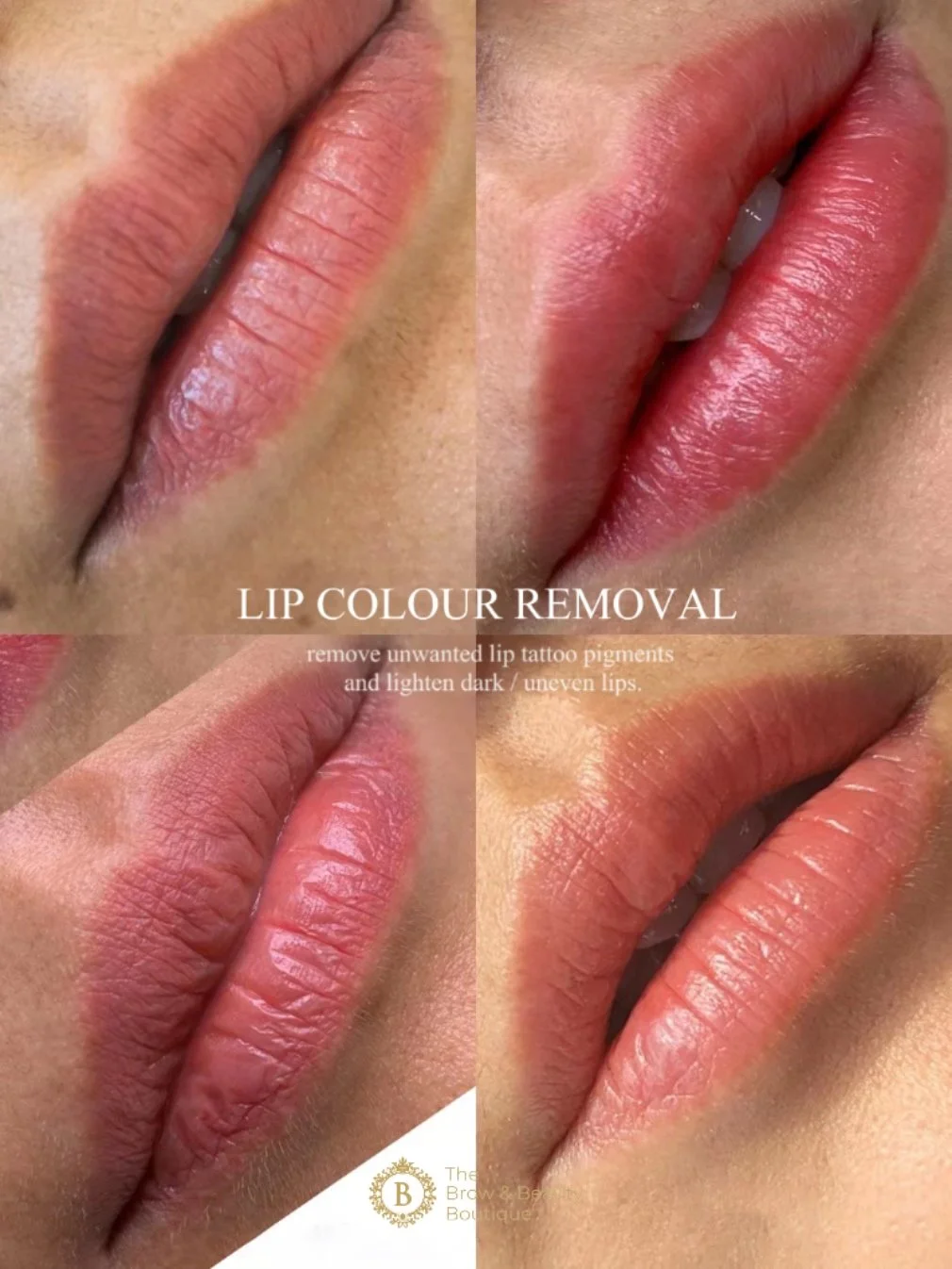


Delayed colour stabilisation is one of the most misunderstood outcomes in lip blush treatments. Clients are often told to “wait it out,” reassured that colour will settle with time. While patience is sometimes appropriate, prolonged instability is not always a normal healing variation. When lip colour continues to shift, dull, cool, or behave unpredictably months after clinical healing, the issue is rarely time alone. It is usually structural.
At The Brow & Beauty Boutique, delayed colour stabilisation is recognised as a biological response to residual pigment and cumulative pigment load, not a superficial or emotional concern. In many cases, prior lip colour removal is the key step that allows stabilisation to occur properly.
What Delayed Colour Stabilisation Actually Is
Delayed colour stabilisation refers to lip pigment that fails to reach a consistent, predictable tone within the expected post-healing window. The lips may appear to cycle through different hues, fluctuate in saturation, or settle unevenly across the vermilion zone.
This is not the same as early healing changes. True delayed stabilisation persists well beyond tissue recovery and is often characterised by:
Ongoing tone shifts between warm and cool
Uneven colour density across different lip zones
Areas that darken, grey, or mute over time
Difficulty achieving consistent results with touch-ups
These patterns signal that pigment behaviour beneath the surface remains unstable.
Why Time Alone Often Does Not Resolve the Issue
Lip tissue heals quickly, but pigment behaviour stabilises more slowly. However, when stabilisation is excessively delayed, waiting longer rarely fixes the root problem. This is because delayed stabilisation is often driven by residual or layered pigment, not by slow healing.
Common underlying contributors include:
Deeply placed pigment that continues to influence hue
Residual pigment from earlier treatments interfering optically
Over-saturation that limits light reflection
Mixed pigment systems reacting differently over time
As long as these factors remain present, colour continues to fluctuate regardless of how much time passes.
The Role of Residual Pigment in Colour Instability
Residual pigment does not fade evenly or behave passively. Older pigment may sit deeper in the dermis, while newer pigment occupies more superficial layers. These layers interact continuously as light passes through the lip tissue.
This interaction can cause:
Cool undertones to dominate unpredictably
Patchy colour output despite even application
Delayed oxidative colour changes
Reduced clarity and vibrancy over time
Without addressing residual pigment, attempts to stabilise colour through additional embroidery often compound the problem rather than resolve it.
Why Prior Lip Colour Removal Enables Stabilisation
In cases of delayed stabilisation, lip colour removal is not about erasing work. It is about removing interference.
Selective pigment reduction allows the tissue to reset and respond more predictably. By reducing pigment density and clearing unstable layers, removal creates conditions where colour can finally stabilise.
Prior removal helps to:
Reduce cumulative pigment load
Lighten deep or cool-toned residual pigment
Improve light penetration through the vermilion
Restore a predictable healing and settling pattern
This is why removal is often recommended before attempting further colour work. It is a preparatory step that enables long-term success. Learn more about this corrective foundation through our lip colour removal service.
Why Touch-Ups Without Removal Often Prolong Instability
Repeated touch-ups are a common response to delayed stabilisation, but they frequently worsen outcomes. Adding more pigment to already unstable tissue increases pigment density and deepens unpredictability.
Over time, this leads to:
Longer stabilisation periods after each session
Escalating colour distortion
Reduced correction options
Increased tissue stress
At The Brow & Beauty Boutique, delayed stabilisation is treated as a signal to pause, reassess, and reduce—rather than to continue layering.
Stabilisation Before Embroidery Refinement
Once residual pigment has been reduced and the tissue allowed to recalibrate, colour behaviour changes noticeably. The lips settle faster, tone remains more consistent, and healing outcomes become easier to predict.
Only at this stage does lip embroidery become truly effective as a refinement tool rather than a corrective gamble.
When performed on stabilised tissue, embroidery:
Produces more even colour distribution
Maintains warmth and clarity over time
Reduces the need for repeated corrections
Clients may explore this refinement stage through lip embroidery blush or lip embroidery enhancement once stabilisation has been achieved.
Why Sequencing Determines Outcomes
Delayed colour stabilisation highlights the importance of sequencing. Correction is not about doing everything at once. It is about addressing interference first, then refining.
At The Brow & Beauty Boutique, this process is guided by:
Careful evaluation of pigment history
Honest discussion of limitations and timelines
Risk-managed correction planning
Respect for biological variability
Clients are encouraged to ask questions and understand why certain steps are recommended, ensuring clarity rather than false reassurance.
For insight into how delayed stabilisation has been managed successfully in real cases, our customer stories offer helpful context.
When Stabilisation Finally Becomes Possible
Delayed colour stabilisation is not a dead end. It is an indication that the lips need reduction before refinement. Prior lip colour removal often provides the reset required for pigment to behave normally again.
If your lip colour continues to change long after healing, the solution is not to wait indefinitely or add more pigment. It is to remove what is interfering first.
You may begin the appropriate stage directly by scheduling:
To learn more about our correction philosophy and services, visit The Brow & Beauty Boutique.
