Why Legacy Lip Tattoo Work Creates Structural Pigment Interference


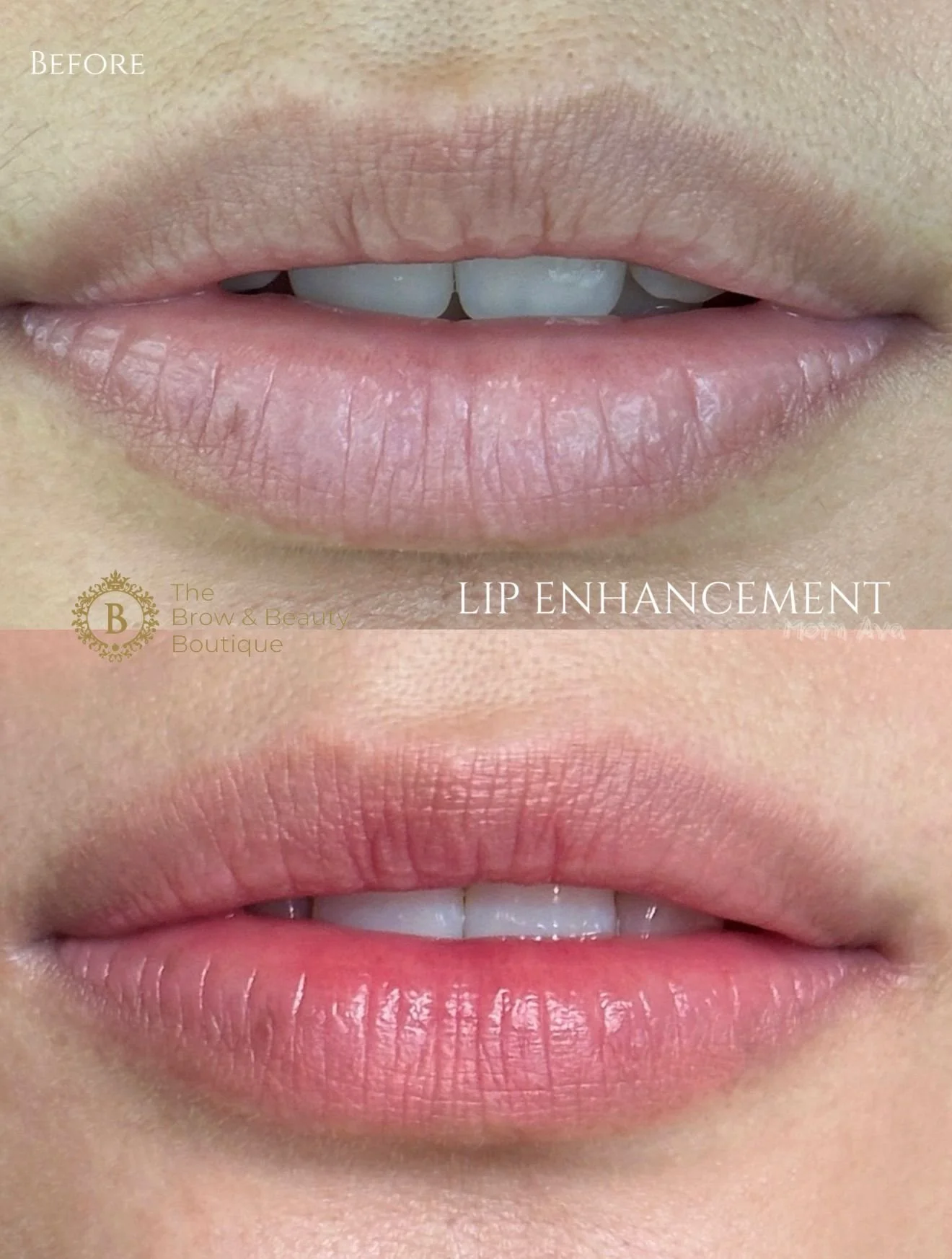

Many clients seeking lip correction share a similar experience: their lips were treated years ago, healed without incident, and remained untouched for a long time. Yet when they later attempt refinement or enhancement, the results behave unpredictably. Colour shifts unexpectedly, saturation appears uneven, or new pigment fails to settle as intended. This is not coincidence. It is most often the result of structural pigment interference caused by legacy lip tattoo work.
At The Brow & Beauty Boutique, legacy pigment is approached as a structural factor rather than a historical footnote. Even pigment placed many years ago can continue to influence how lips respond to new treatments, particularly when correction or embroidery is attempted without proper sequencing.
What Is Legacy Lip Pigment?
Legacy lip pigment refers to residual pigment remaining in the dermal layers from previous lip tattoo or blush procedures. While surface colour may have faded significantly, pigment often persists beneath the visible layer of skin.
This pigment may be:
Embedded at varying depths
Unevenly distributed across the vermilion
Chemically altered through oxidation over time
Interacting with newer pigment applications
Because lip tissue does not regenerate in a way that removes dermal pigment naturally, legacy pigment remains biologically active. It continues to affect colour behaviour, light reflection, and healing response long after the original treatment.
How Structural Pigment Interference Develops
Structural pigment interference occurs when existing pigment disrupts the behaviour of newly introduced pigment. This disruption is not always visible immediately. In many cases, lips appear acceptable during early healing, only to reveal instability weeks or months later.
Common mechanisms include:
New pigment settling above older, cooler-toned pigment
Layered pigment causing optical colour distortion
Uneven pigment density altering light absorption
Deep residual pigment pulling colour towards grey or purple
These interactions happen at the dermal level, meaning they cannot be corrected reliably by surface adjustments alone.
Why Adding More Pigment Rarely Resolves the Issue
A common response to unsatisfactory lip outcomes is to apply additional colour in an attempt to override the old. Unfortunately, this approach often intensifies structural interference.
Layering pigment without addressing what already exists can lead to:
Increased pigment load imbalance
Greater depth inconsistency
Higher risk of chromatic instability
Reduced long-term predictability
Rather than neutralising the problem, additional pigment compounds it. Over time, correction options become more limited, not more flexible.
This is why legacy pigment must be evaluated and managed before refinement is attempted.
Legacy Pigment and Healing Variability
Lip tissue heals unevenly by nature. Vascularity, movement, and thickness vary across the vermilion zone. When legacy pigment is present, these biological differences become more pronounced.
Areas with deeper or denser residual pigment may:
Heal darker or cooler
Retain colour longer than surrounding tissue
Respond differently to new pigment placement
This variability is not a sign of poor aftercare or incorrect healing. It is a structural response to pigment history.
Understanding this distinction is critical for clients who feel confused or discouraged by inconsistent outcomes.
The Role of Lip Colour Removal in Managing Interference
When structural pigment interference is present, lip colour removal becomes an essential corrective tool. The objective is not always complete removal. In many cases, targeted pigment reduction is sufficient to restore balance.
Selective removal helps to:
Reduce deep residual pigment
Lighten oversaturated zones
Improve colour clarity
Re-establish predictability for future embroidery
By recalibrating the pigment environment, removal creates a stable foundation rather than a blank slate. This controlled approach significantly improves long-term outcomes. You can learn more about this step through our lip colour removal service.
Why Lip Embroidery Works Best After Interference Is Resolved
Once legacy pigment has been managed appropriately, lip embroidery behaves more consistently. Pigment settles with greater uniformity, undertones remain stable, and healing outcomes become easier to predict.
This is why embroidery is positioned as a completion phase, not a corrective shortcut. When performed on structurally balanced tissue, it enhances natural lip tone rather than compensating for underlying instability.
Clients considering refinement after correction may explore lip embroidery blush or lip embroidery enhancement as the final step in their journey.
Process Is What Prevents Repeat Disappointment
One of the defining principles at The Brow & Beauty Boutique is that successful outcomes depend on process, not optimism. Legacy pigment is never ignored, rushed, or painted over.
Each case involves:
Assessment of pigment depth and distribution
Evaluation of tissue tolerance and healing capacity
Clear explanation of sequencing and limitations
A correction-led plan tailored to the individual
Clients are encouraged to ask questions and understand why certain steps are recommended. This ensures informed decisions rather than reactive ones.
For insight into how complex legacy cases have been handled, our customer stories provide real-world correction examples.
When the Past Affects the Present
Legacy lip tattoo work does not mean your lips are beyond repair. It simply means the past must be respected before the future can be refined. Structural pigment interference is not a failure—it is a signal that correction must come before enhancement.
If previous lip work continues to affect your results, the next step is not more colour. It is better sequencing.
You may begin the appropriate phase directly by scheduling:
For a broader understanding of our philosophy and standards, you may also visit The Brow & Beauty Boutique.