Eyeliner that sits wider than the eye’s natural structure can subtly, but significantly, change how the eyes are perceived. Instead of enhancing definition, the line may dominate the eyelid, shorten the visible eye space, or make the eye appear heavier or more closed. From a professional perspective, this is not simply a style preference issue. It reflects a mismatch between pigment placement and periocular anatomy.
At The Brow & Beauty Boutique, this concern is addressed through medical-led assessment and controlled periocular correction. The objective is not to erase eyeliner indiscriminately, but to restore proportional alignment so the eyeliner supports the eye’s natural structure rather than competing with it.
Why Eyeliner Can Appear Too Wide Over Time
In the periocular region, width is not determined solely by how thick a line was originally drawn. It is influenced by pigment depth, density, and long-term tissue interaction. Eyelid skin is thin, mobile, and constantly affected by blinking and facial expression. When pigment is implanted too deeply or with excessive saturation, its visual footprint can expand over time.
Several mechanisms contribute to an overly wide appearance:
Pigment diffusion can soften edges, increasing perceived width even when the original placement has not migrated significantly. Density consolidation after healing may make the eyeliner appear darker and heavier, amplifying its visual dominance. In some cases, subtle downward or outward migration creates shadowing that visually broadens the line beyond its intended borders.
Anatomical changes also play a role. As eyelid structure evolves with age, a line that once felt balanced may no longer sit harmoniously within the available lid space. What remains static is the pigment. What changes is the eye.


Why Redrawing the Eyeliner Rarely Fixes the Problem
When eyeliner feels too wide, a common reaction is to attempt to redefine it by adding pigment above or reshaping the line. In the periocular region, this approach often worsens the imbalance. Adding pigment increases density and visual weight, making the eyeliner appear even broader and more dominant.
More importantly, re-tattooing masks critical diagnostic information. Once new pigment is layered over existing density, it becomes more difficult to assess where excess width originates and how the pigment is behaving beneath the surface. This reduces the precision of any future correction.
Medical-led correction avoids this cycle by focusing on selective width reduction, not compensation through additional pigment.
Assessment Determines Whether Width Can Be Reduced Safely
Before any correction is attempted, a structured periocular assessment is essential. This evaluation examines how the eyeliner sits relative to the eye’s natural anatomy and why it appears overly wide.
Key factors include pigment depth variation, density distribution across the eyelid margin, the presence of diffusion or migration, and how the eyeliner interacts with the natural curvature of the lid. Tissue reactivity and healing capacity are also considered, as these influence how safely reduction can be staged.
The clinic’s framework for professional eyeliner colour correction in Singapore explains how these assessments guide conservative, anatomy-respecting correction strategies rather than aggressive removal.
Begin With an Anatomical Eyeliner Assessment
If your eyeliner feels too wide for your eye shape, guessing the solution can lead to further imbalance. A professional consultation allows your specialist to explain whether width reduction is appropriate and how it would be approached safely.
Book an eyeliner correction consultation to receive guidance grounded in anatomy, pigment behaviour, and periocular safety rather than surface appearance alone.
How Controlled Width Reduction Works
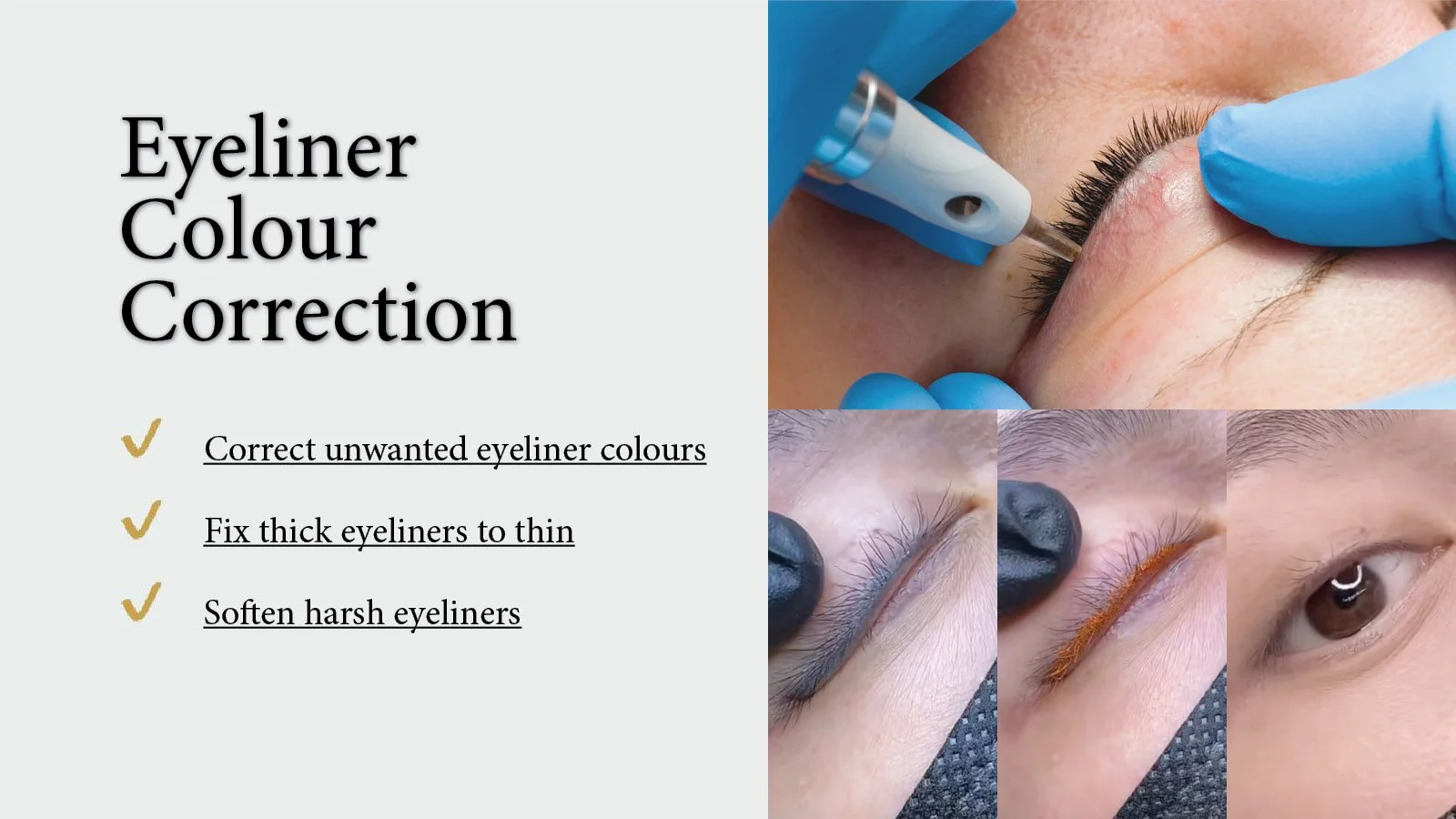
Correcting overly wide eyeliner is rarely about full removal. In many cases, the goal is incremental pigment reduction, selectively addressing areas where visual width exceeds anatomical support.
This staged approach allows specialists to soften edges, reduce excess density, and bring the eyeliner back into proportion with the eye. By working gradually, tissue recovery can be observed between sessions, and correction intensity can be adjusted based on pigment response.
Importantly, this process respects the biological limits of the periocular region. Aggressive intervention risks inflammation and instability, while controlled reduction prioritises predictability and long-term eye health.
Restoring Proportion Without Flattening the Eye
One concern clients often have is that reducing eyeliner width will leave the eye looking bare or undefined. Medical-led correction is designed to avoid this outcome. The focus is on restoring proportion, not eliminating definition.
By narrowing the visual footprint of the eyeliner and re-establishing clean borders, the eye regains prominence. Lash definition appears sharper, and the eyelid space feels more open, even when pigment remains present.
This is why reduction is guided by anatomy rather than trends. The goal is to support the eye’s natural structure, not impose a one-size-fits-all thickness.
When Refinement Becomes an Option
Once width has been reduced and pigment behaviour stabilised, some clients choose to refine their eyeliner. This step is optional and always sequenced after correction, never used to mask unresolved width issues.
Modern eyeliner embroidery techniques prioritise superficial dermal placement and controlled saturation, allowing definition to be reintroduced without recreating excess width. Clients exploring this phase may review eyeliner embroidery services in Singapore, including subtle options such as baby eyeliner for refined lash enhancement or classic eyeliner for structured yet balanced definition.
These options are considered only once the eyeliner sits comfortably within the eye’s natural proportions.
Supporting Periocular Skin During Correction
Width reduction outcomes are influenced not only by technique, but also by how well periocular tissue recovers between stages. Supporting hydration, circulation, and barrier integrity improves comfort and predictability.
Many clients incorporate supportive care such as the La Dermalogique Eye Spa – Iris Clarity treatment during their correction journey. This adjunctive care supports periocular calmness without interfering with pigment protocols.
Proportion Is an Anatomical Issue, Not a Style Mistake
Eyeliner that sits too wide for the eye’s natural structure does not require concealment or aggressive removal. It requires assessment-led, incremental correction that respects periocular anatomy and long-term pigment behaviour.
With controlled reduction and thoughtful sequencing, eyeliner can be brought back into proportion, allowing the eye itself to take centre stage again.
Schedule your professional eyeliner correction consultation to begin a correction journey focused on anatomy, safety & lasting balance.