
Correcting Deep Dermal Lip Pigment Placement Through Targeted Colour Removal


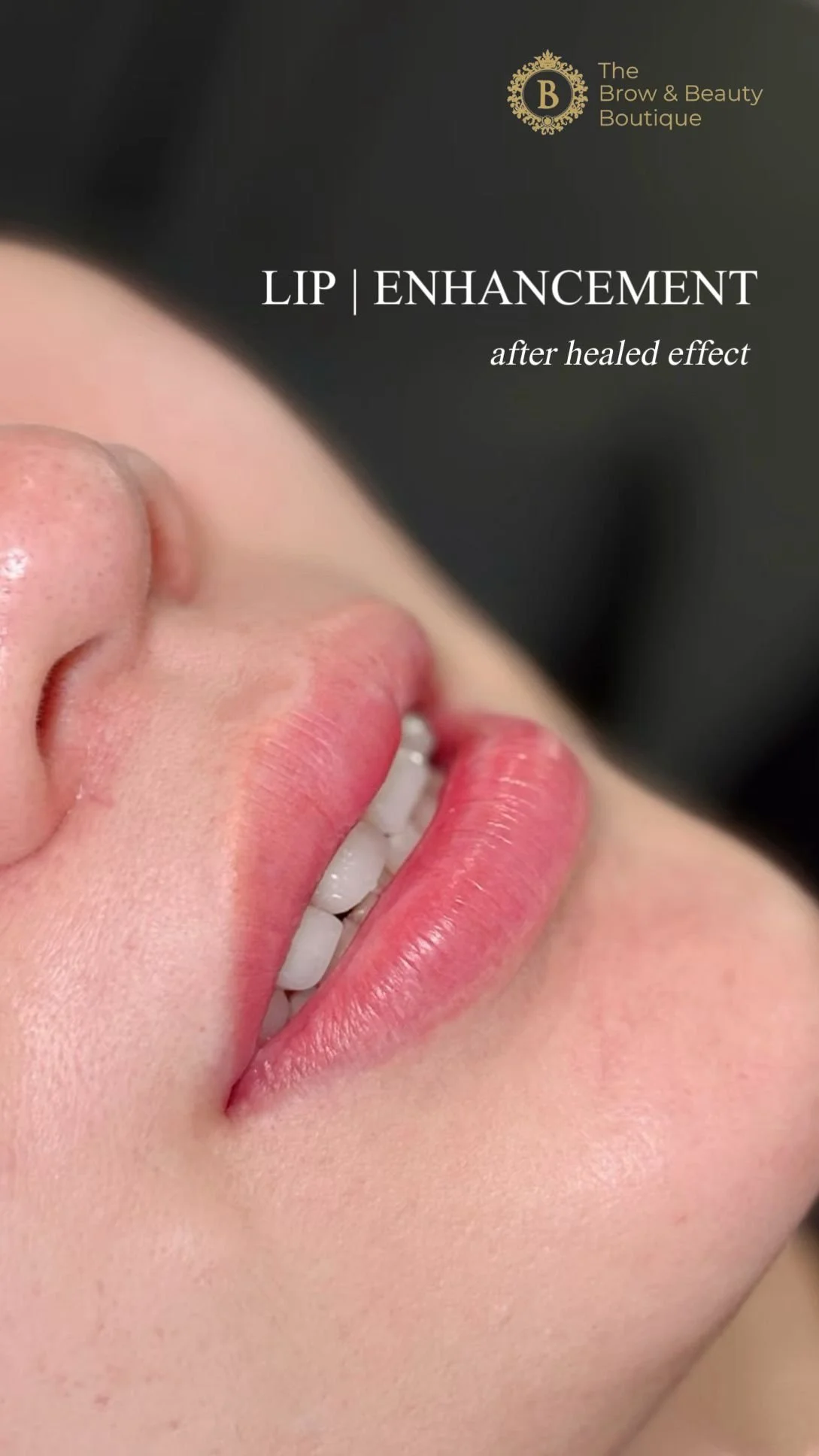
One of the most challenging lip correction cases involves pigment that has been placed too deeply within the dermal layers. These results often heal smoothly on the surface, yet the colour outcome feels heavy, cool, muted, or resistant to refinement. In such cases, the issue is not poor healing or incorrect aftercare. It is deep dermal pigment placement, and it fundamentally changes how colour behaves in the lips.
At The Brow & Beauty Boutique, deep dermal pigment placement is treated as a structural concern that requires targeted colour removal, not additional pigment. Understanding why depth matters is essential to correcting these outcomes safely and predictably.
Why Pigment Depth Determines Long-Term Lip Colour
Lip pigment is designed to sit within a specific, narrow layer of tissue. When pigment is placed too deeply, it interacts differently with light, blood flow, and natural undertones. Rather than reflecting warmth and translucency, deep pigment absorbs light and amplifies cooler wavelengths.
This often results in lips that appear:
Grey, purple, or bluish over time
Dense or opaque rather than soft
Resistant to neutralisation
Inconsistent across different lighting conditions
Crucially, these outcomes can occur even when pigment choice and colour theory were sound at the time of treatment. Depth alone is enough to destabilise results.
How Deep Dermal Placement Happens
Deep placement is rarely intentional. It usually develops through:
Excessive pressure during implantation
Repeated passes in the same area
Multiple touch-ups layered without reduction
Attempting to “force” colour retention
Each of these increases the likelihood that pigment migrates beyond the ideal zone. Once embedded deeply, the pigment becomes biologically stable but aesthetically unstable, meaning it remains in the tissue while producing undesirable colour effects.
Why Colour Correction Alone Cannot Fix Deep Pigment
When pigment sits too deep, surface-level correction strategies stop working. Neutralisation, warm overlays, or colour balancing techniques may temporarily soften the appearance, but they do not alter how light interacts with the pigment beneath the surface.
Adding more pigment over deeply placed colour often:
Increases density and opacity
Exacerbates cool or muddy tones
Further limits future correction options
This is why deep dermal pigment placement must be addressed through reduction, not coverage.
Targeted Lip Colour Removal as a Corrective Tool
Targeted lip colour removal is the most effective way to address pigment that sits too deeply. Rather than erasing all pigment indiscriminately, targeted removal focuses on reducing density and depth in specific zones where instability originates.
This approach allows for:
Lightening of deep, cool-toned pigment
Improved light reflection through the tissue
Restoration of translucency
Greater predictability for future embroidery
Importantly, targeted removal respects tissue integrity. It is designed to recalibrate pigment behaviour, not traumatise the lips further. You can learn more about this corrective step through our lip colour removal service.
Why Reduction Creates Better Conditions for Correction
Once deep pigment load is reduced, the lips behave differently. Healing becomes more uniform, undertones stabilise, and colour interactions become easier to predict. This creates the conditions necessary for true correction, rather than ongoing compensation.
Targeted removal also prevents the escalation cycle where each corrective attempt worsens the original issue. Instead of chasing colour, the process restores balance.
Lip Embroidery After Depth Correction
After deep dermal pigment has been adequately reduced and the tissue has stabilised, lip embroidery becomes significantly more reliable. Pigment can be placed at the correct depth, allowing colour to heal softly and evenly.
This is why embroidery is positioned as a completion phase, not a shortcut. When performed on recalibrated tissue, embroidery enhances natural tone and shape without reintroducing instability.
Clients ready for this stage may explore:
Lip Embroidery Blush for natural, translucent colour
Lip Embroidery Enhancement for refining existing work
Why Assessment and Sequencing Are Non-Negotiable
Correcting deep dermal pigment placement requires judgement, not guesswork. At The Brow & Beauty Boutique, every correction plan begins with an honest assessment of:
Pigment depth and distribution
Tissue response and healing history
The feasibility of immediate embroidery
The necessity and scope of removal
Clients are guided through the reasoning behind each step so decisions are informed and expectations remain realistic. For insight into how complex cases are resolved over time, our customer stories provide helpful perspective.
Depth Issues Require Reduction, Not Repetition
Deep dermal pigment placement is not corrected by adding more colour or waiting longer. Without intervention, the pigment will continue to behave as it always has. Targeted colour removal provides the only reliable path toward restoring translucency and predictability.
If your lips appear heavy, cool-toned, or resistant to correction despite healing well, the issue may lie in pigment depth rather than pigment choice.
You may begin the appropriate stage directly:
For an overview of our approach and philosophy, visit The Brow & Beauty Boutique.