When Lip Neutralisation Fails Due to Undertone Dominance



Lip neutralisation is often presented as a solution for uneven, dark, cool-toned, or discoloured lips. In many cases, it does help rebalance colour and improve overall appearance. However, there is a subset of clients who experience disappointing or short-lived results even when neutralisation is performed correctly and healing proceeds without complications. When this happens, the underlying issue is frequently undertone dominance rather than technique failure.
At The Brow & Beauty Boutique, failed neutralisation is approached as a diagnostic signal. It indicates that the lips are expressing a deeper chromatic influence that must be addressed structurally before aesthetic refinement can succeed.
What Lip Neutralisation Is Designed to Do
Lip neutralisation works by introducing corrective pigment tones to counteract unwanted hues. For example, warm pigments may be used to offset cool or grey tones, while balancing colours help soften darkness or unevenness.
When conditions are favourable, neutralisation can:
Improve colour harmony
Reduce visual darkness
Create a base suitable for further enhancement
However, neutralisation operates within a predictability window. When biological and pigment-related variables exceed that window, results become unstable.
Understanding Undertone Dominance
Undertone dominance occurs when the natural colour influence of the lips consistently overpowers applied pigment. This influence may stem from:
Strong vascular undertones within the vermilion zone
High melanin response in the labial tissue
Deep residual pigment from previous lip tattoo work
Pigment placed at depths where cooler wavelengths dominate
In these cases, corrective pigment does not remain visually dominant once healing stabilises. Instead, the underlying undertone reasserts itself, causing colour to drift back toward grey, purple, or muted tones.
This is not a failure of neutralisation. It is a mismatch between technique and tissue behaviour.
Why Neutralisation Can Appear to “Work” at First
One of the most confusing aspects of undertone dominance is delayed colour shift. Lips may appear balanced during early healing, only to change weeks later.
This happens because:
Surface pigment stabilises before deeper layers fully settle
Vascular and melanin influence becomes more visible as inflammation resolves
Optical colour interaction evolves as the healing cascade completes
By the time undertone dominance becomes evident, clients often feel they have already “given neutralisation a fair chance.”
Why Re-Neutralising Rarely Solves the Problem
When neutralisation fails due to undertone dominance, repeating the same approach often worsens outcomes rather than improving them.
Additional neutralisation layers can lead to:
Increased pigment load
Greater depth inconsistency
Reduced colour clarity
Heightened risk of long-term instability
Rather than overpowering the undertone, repeated applications tend to compound chromatic imbalance. This is why strategic reassessment is essential instead of escalation.
The Role of Lip Colour Removal in Addressing Dominance
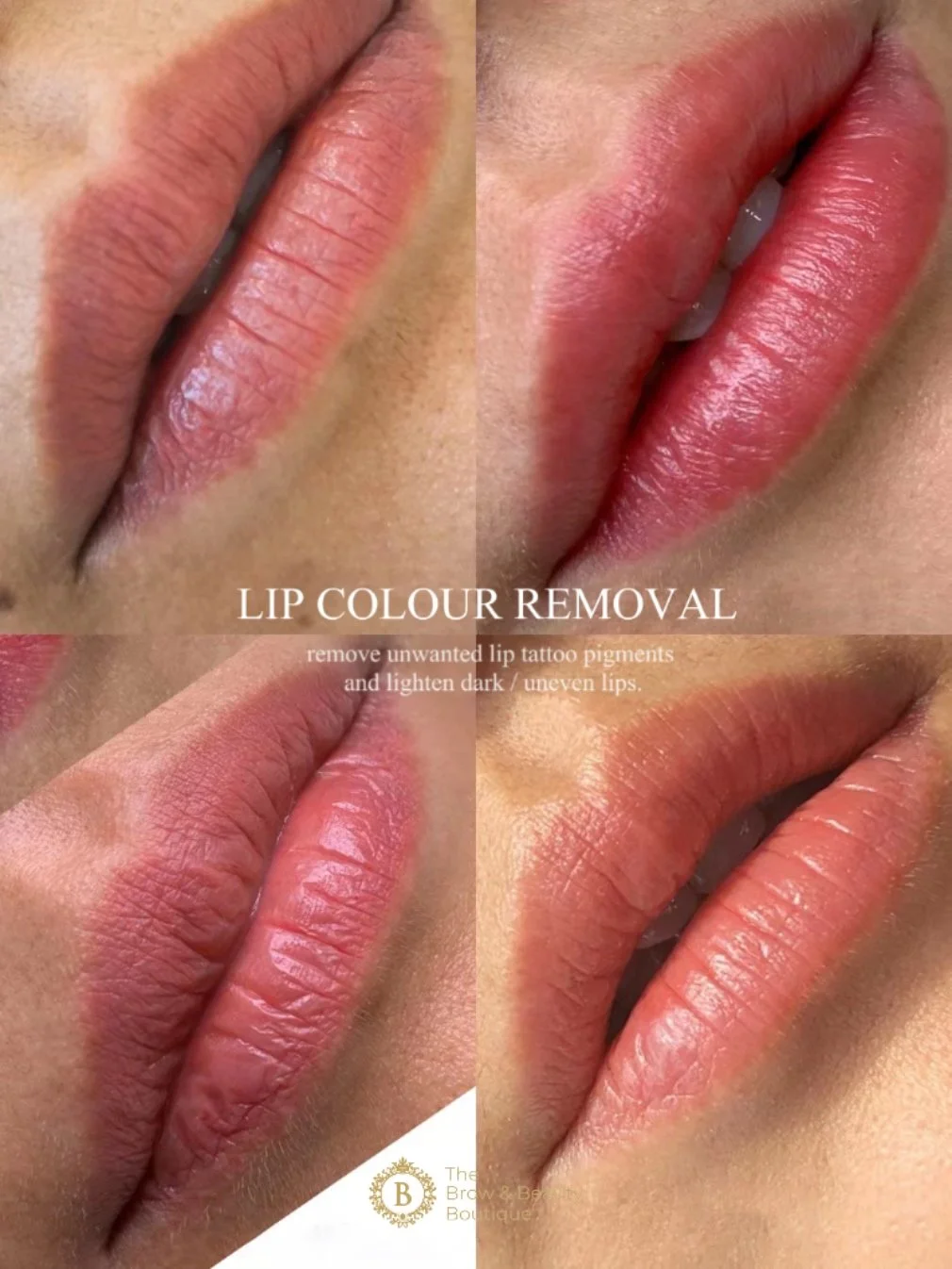
When undertone dominance is present, lip colour removal becomes an important corrective step. The purpose is not erasure, but structural recalibration.
Targeted removal can:
Reduce competing residual pigment
Lighten dense or cool-toned zones
Improve light reflection within the tissue
Expand the predictability window for future work
By reducing chromatic interference, the lips become more responsive to correction and refinement. This step is often what allows neutralisation or embroidery to succeed later where it previously failed.
You may learn more about this corrective phase through our lip colour removal service.
Why Embroidery Works After Undertone Control
Once undertone dominance has been moderated, lip embroidery becomes significantly more reliable. Pigment no longer competes as aggressively with underlying colour forces, allowing warmth, softness, and balance to remain stable over time.
This is why embroidery is positioned as a completion stage, not a compensatory fix. When applied to a stabilised foundation, it enhances rather than corrects.
Clients ready for refinement after correction may explore:
Both services are designed to work with corrected lips, not against unresolved structural issues.
Process Discipline Over Quick Fixes
One of the defining standards at The Brow & Beauty Boutique is that failed outcomes are analysed, not dismissed. When neutralisation does not hold, the response is not to repeat it blindly.
Instead, each case involves:
Assessment of undertone strength and pigment history
Evaluation of tissue tolerance and healing variability
Honest discussion of limitations and sequencing
A correction-first plan built around long-term stability
Clients are encouraged to ask questions and understand why certain steps are recommended before proceeding.
To see how complex cases have been resolved through proper sequencing, our customer stories provide real-world examples of correction-led outcomes.
When Neutralisation Is Not the Final Answer
Lip neutralisation is a valuable tool—but it is not universally effective. When undertone dominance is present, the lips are communicating that foundation work must come before refinement.
This does not mean your lips cannot be improved. It means they require a different pathway.
If neutralisation has failed to deliver stable results, the next step is not more colour. It is controlled correction followed by intentional embroidery.
You may begin the appropriate phase directly by scheduling:
For a broader understanding of our standards and approach, you may also visit The Brow & Beauty Boutique.