
How Lip Color Removal Restores Symmetry in Over-Saturated Lips


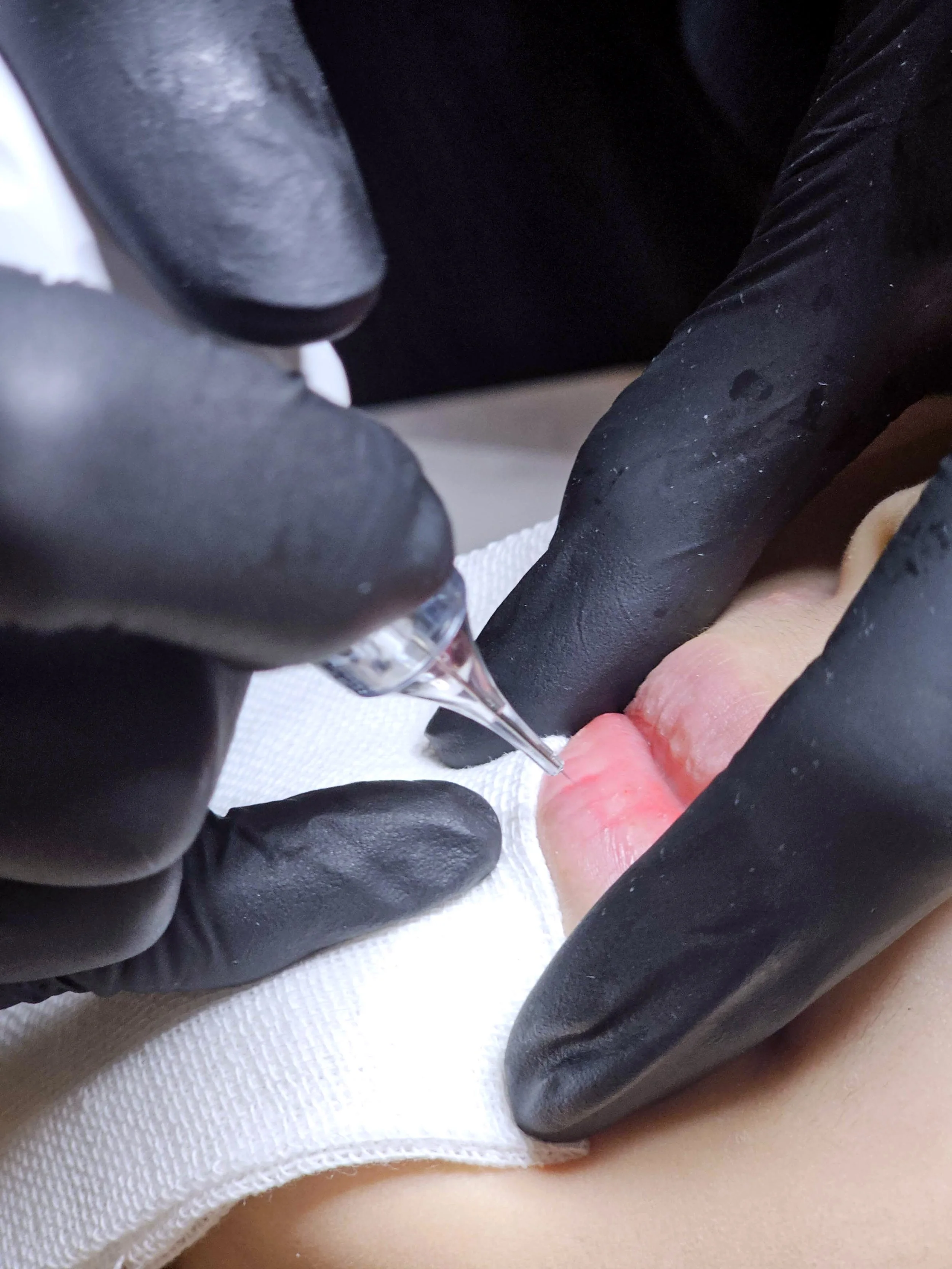
Lip asymmetry is not always a shape problem. In many clinically healed lip blush cases, the lips appear structurally even, yet the colour distribution feels unbalanced. One side may look darker, heavier, cooler, or more opaque than the other. Corners may appear dense while the centre looks faded. This is not a coincidence. It is one of the most reliable indicators of over-saturation and uneven pigment load.
At The Brow & Beauty Boutique, lip colour removal is frequently used not to erase colour, but to restore symmetry by correcting how pigment is distributed and how it behaves within the vermilion zone.
Why Over-Saturation Disrupts Lip Symmetry
Over-saturation occurs when pigment density exceeds what the lip tissue can distribute evenly. This may happen through repeated touch-ups, heavy initial implantation, or attempts to “force” colour retention in areas that fade faster.
While the lips may heal without complications, over-saturated pigment behaves differently across the surface of the mouth due to natural anatomical variation. The vermilion zone is not uniform. Blood supply, tissue thickness, and movement differ between the centre, borders, and corners of the lips.
When pigment load is excessive, these natural differences become visually exaggerated, leading to:
One side appearing darker or cooler than the other
Corners healing heavier than the central lip
Patchy opacity instead of soft translucency
Colour imbalance that becomes more obvious over time
The result is chromatic asymmetry, even when the lip shape itself is symmetrical.
Why Adding More Colour Makes Asymmetry Worse
A common response to uneven lips is to add pigment to the lighter side in an attempt to “balance” colour. Unfortunately, this approach often worsens the underlying issue.
Adding pigment to over-saturated lips increases cumulative pigment load and deepens placement variability. Instead of equalising colour, it often creates:
Further density imbalance
Increased depth inconsistency
Cooler or muddier tones
Reduced long-term predictability
At this stage, symmetry cannot be achieved through addition. The tissue is no longer responding evenly because the pigment foundation is compromised.
Over-Saturation as a Structural Issue, Not a Cosmetic One
It is important to understand that over-saturation is not simply “too much colour.” It is a structural imbalance within the tissue.
When pigment density differs across zones, light passes through each area differently. Heavier zones absorb more light and appear darker or cooler. Lighter zones reflect more light and appear softer or warmer. This optical imbalance is what creates the perception of asymmetry.
True correction requires recalibrating pigment load so the tissue behaves uniformly again.
How Lip Colour Removal Restores Balance
Lip colour removal is the most effective way to restore symmetry in over-saturated lips because it addresses the problem at its source. Rather than masking imbalance, removal reduces excess pigment where density is too high.
Targeted removal allows for:
Lightening of oversaturated zones
Reduction of deep, heavy pigment
Improved light reflection across the lips
More even tissue response during healing
Importantly, removal is rarely applied uniformly across the entire lip. It is often selective, focusing on areas that carry excessive pigment load while preserving zones that already behave well.
This creates a more even chromatic foundation, allowing the lips to regain visual symmetry. You can learn more about this corrective step through our lip colour removal service.
Why Symmetry Improves After Reduction, Not Immediately
Restoring symmetry through removal is not an instant visual transformation. The goal of removal is not immediate perfection, but behavioural normalisation.
Once excess pigment is reduced, the lips are allowed to stabilise. During this period, tissue response becomes more uniform, undertones settle, and colour behaviour evens out. Only after this stabilisation phase can true refinement occur.
This disciplined sequencing prevents the cycle of over-correction that leads to further imbalance.
Lip Embroidery After Symmetry Is Restored
Once pigment load has been balanced and symmetry restored at the structural level, lip embroidery becomes significantly more reliable. Colour can be placed evenly, at the correct depth, without fighting against uneven tissue behaviour.
At this stage:
Colour retention is more consistent
Undertones remain stable
Symmetry is maintained long-term
This is why embroidery is positioned as a completion phase, not a corrective shortcut. Clients may explore refinement through:
Lip Embroidery Blush for natural, even colour
Lip Embroidery Enhancement for refining existing work after correction
Why Assessment Determines the Outcome
Not all asymmetry requires removal, and not all lips require full reduction. The key is accurate assessment. At The Brow & Beauty Boutique, consultations focus on identifying:
Whether asymmetry is pigment-based or shape-based
Which zones carry excessive pigment load
Whether removal is necessary before embroidery
How many stages are required for stable results
Clients are guided through the reasoning behind each recommendation so decisions feel informed rather than reactive. For insight into how similar cases have been resolved, our customer stories offer real-world perspective.
Symmetry Is a Behavioural Outcome
True lip symmetry is not created by adding colour until both sides look similar. It is achieved when pigment behaves consistently across the vermilion zone.
If your lips appear uneven despite proper healing, the cause may be over-saturation rather than technique or aftercare. In these cases, lip colour removal provides the reset needed to restore balance before refinement.
You may begin the appropriate stage directly:
For an overview of our correction-first philosophy and services, visit The Brow & Beauty Boutique.